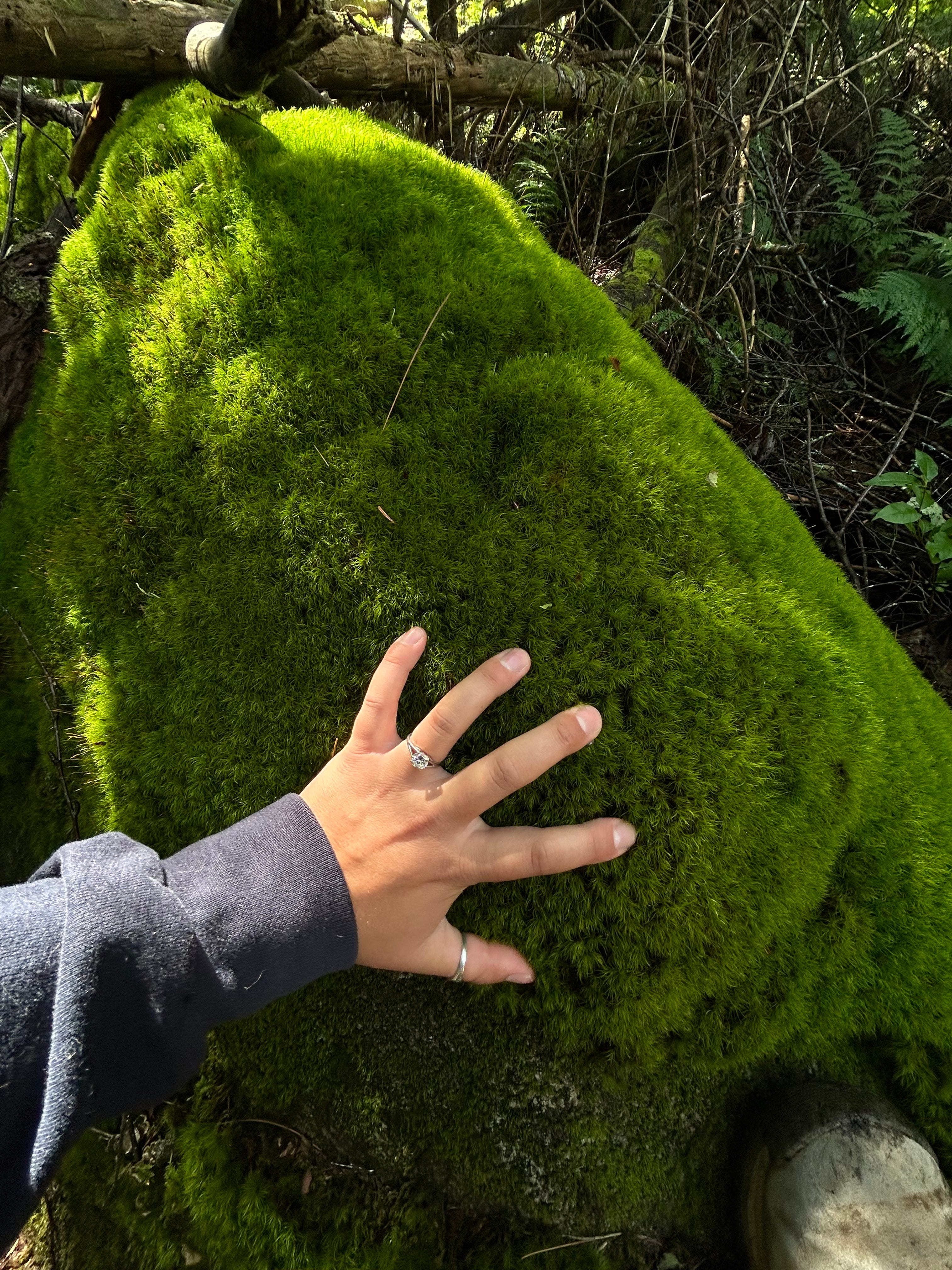
In one very real sense, modernity has expanded the number of people and systems our lives depend on.
And yet we encounter very little of it firsthand.
I push the sink handle, and water comes out.
I flush my toilet, the shit disappears.
I go to the store, and a pound of boneless chicken breasts is pre-packaged, priced at a Safeway Rewards discount, and ready for me to eat.
There are people, materials, ecosystems, infrastructure, knowledge, and incredibly complicated processes on the other side of these outputs.
But I rarely encounter them, and so they can feel invisible – I experience the output without experiencing what produced it.
Our ancestors had immediate points of contact with the world around them: their family, community, traditions, responsibilities, religious beliefs, cultural beliefs, and the needs immediately around them.
(i also realize I’m being an ignorant American and that many, many people in today’s world still experience the world this way)
From my perspective — raised as a secular-minded American who had basically no understanding of my background, and who also wasn’t brought up with much spirituality or belief in a higher order — it can feel like I was just kinda dropped into this world.
No real recognition of the past or ancestors who came before me.
And being non-religious, there was no real recognition of the future or what comes after we croak.
Nor a ton of recognition of the people, places, or systems I was part of presently.
And to add more fuel to the fire, there was just a continual build-up of the ego: through messages about our special-ness, a culture that treats individuality as a form of virtue, and directionless “chase your dreams and the money will come” advice…
We were told heroic stories of the self-made individual who picked ‘emselves up by their bootstraps – as if such a person could even exist.
Because the reality is that each of us is downstream from an incomprehensibly long chain of systems, relationships, historical events, economic circumstances, technologies, cultural changes, random encounters, and complete fucking accidents — whether we pay attention to it or not.
And I guess I’m writing this to say… I think it may be beneficial for us to notice.
I wonder if this has something to do with the alienation so many people describe feeling today — the feeling of living a “simulated life”: like you’re somehow removed from the world, watching your life happen rather than fully participating in it.
I don’t know. But I’ve found that the more I notice the ways I’m embedded in the world around me, the less abstract the world starts to feel.
Noticing our embeddedness
I like stories and systems-based explanations for why things are the way they are.
So one way I’ve started noticing my own embeddedness is through history.
→ My family history: This became especially interesting to me after my Dad passed. ‘Cus for a lot of us in the Western World… folks like myself… this is something that was sort of always just glossed over and seen as unimportant (see a forgotten family history).
But the more I’ve paid attention to it and how it’s shaped me, the more rooted I feel in the world. World history becomes personal history.
→ The history of places I travel through: This past summer, driving through the Midwest and Great Lakes, I got into the habit of pulling up ChatGPT’s voice chat and asking about the history of whatever place I happened to be passing through.
A lot of these towns initially registered to me as little more than dreary scenery — old buildings, empty storefronts. Places I’d probably never visit again.
But then you learn who came there and why. What industry built the town. What happened to it. Why it looks the way it does today.
And it makes the same, dreary scenery come alive. It’s not just here… It’s part of a much longer story.
–
And maybe the way you notice your embeddedness in this world is different than the way I want to notice mine (first time that sentence has been written…?) – based on preferences and all that jazz.
→ Maybe you’re more naturally captured by biology than history. So you learn about the trees, the birds, and the migration routes right in your neighborhood…
→ Maybe you’re super passionate about something — baseball, punk music, motorcycles, gardening. Learn where it came from and who came before you.
Not trying to preach that everyone has some civic duty to study local fauna or our family history. I’m saying: holy shit, look around… isn’t there anything here that makes you curious?
There are seemingly endless layers underneath the surface — histories, ecosystems, people, systems, stories. Like we’re walking around this infinitely detailed open-world map and most of us have barely explored any of it.
And once I really noticed and felt that on a visceral level, that’s when I started asking:
What would it actually look like to live in a way that brings you into more contact with life?
Becoming More Embedded
Living in cities taught me there are very different ways to inhabit the same place.
Some people are customers of the city: they rent an apartment here. They work in the city. They spend their money in that city and consume whatever experiences the city makes available to them.
But the city itself isn’t necessarily changed by their being there. They pass through it more like users of a service than participants in a place.
And others are an inextricable part of their city.
They spend enough time in the same places, know enough of the same faces, and develop enough little routines and relationships that eventually they become part of the texture of the place itself.
I picture the dudes in Washington Square Park who spend their days playing chess, smoking cheebah, and catcalling passers-by. These guys are more a part of New York than any dumb building, statue, or tourist attraction.
And this is what I mean when I say we can deliberately become more embedded in our world.
Become a regular at a coffee shop.
Spend enough time in the same nature preserve that you notice it changing.
Organize something in your community.
All completely different on the surface, but they’re getting at the same basic thing: deliberately creating more points of contact between yourself and the world around you.
Becoming less of a spectator and more of a participant. And I’ll be the first to admit: there’s a part of me that fucking hates that.
I don’t particularly enjoy the idea that somebody might need me for something, because then I have the ability to disappoint them. There’s a freedom to having no obligations, no expectations, no one relying on you (duh).
And I’ve valued freedom and autonomy so much that I’ve built a completely remote business where 95% of my work time is spent writing alone, with only a few recurring calls each month.
There’s nothing inherently alienating about that arrangement. But in pursuing that freedom, I also deliberately removed a bunch of recurring points of contact from my working life — coworkers, fixed places, obligations, incidental conversations, people I’d see every day.
And then, early in my career, I’d wonder why I felt a bit disconnected from my life.
Gee, Kyle. What a mystery...
I don’t want to recreate old forms of contact simply because we removed them. I’d rather notice what disappeared, evaluate the honest costs, and decide more deliberately what sorts of contact we want to create in its place.
An example is that industrial agriculture means my family’s survival doesn’t depend on me producing my own food… Great.
One tradeoff is that somebody who had to hunt for their food would probably understand their surrounding ecosystem with an intimacy I simply don’t — the animals, terrain, weather, seasons, plants.
But they also had to spend an enormous amount of time and energy making sure their family didn’t starve.
That gives me time to go deeper somewhere else — learning something, making something, mastering some obscure craft, getting involved in my community, following a curiosity they simply wouldn’t have had the time for.
So maybe the more useful question isn’t whether some technology is “good” or “bad.” It’s…
What points of contact does this remove?
What capacities or relationships were cultivated through that contact?
What new forms of contact does this make possible?
AI is an example that’s sorta pressing. We could genuinely use it to eliminate more and more direct contact with the world:
> Tell me what happened
> Write this thing
> Give me the answer
> Make the decision
As the kids would say, that’s simulation-maxxing. Used that way, AI becomes another layer between me and the thing itself.
But the same tool can help us go deeper.
Why is my town shaped this way? What is this tree outside of my apartment?
How does the sewage system underneath my feet actually work?
Here is my argument – what assumptions am I making here?
The AI tools can give me more ways to inquire about the particular places, systems, histories, people, or problems that are already in front of me.
It Makes Me Hopeful
On the Tetragrammaton Podcast, Rick Rubin asked musician Jack Johnson about the beach cleanups he supports in Hawaii.
Jack –
“If you’re only gonna go to the beach for a day, don’t make it a beach clean up. The beach clean-up should be for people like myself who get to spend so much time down there and have the responsibility.
Otherwise, you wanna take your kid to enjoy nature. You don’t wanna... hit him over the head with the problem.
As they grow older, they’ll protect the things that they love and if they love nature, they’ll help protect it.”
Listening to this, I had one of those oh shit moments when something resonates on that deep, visceral level… allow them to fall in love with nature, and they’ll naturally want to protect what they love.
I think it’s a beautiful little framework to approach our entire world with, way beyond ocean conservation.
If we create the conditions for more of us to fall in love with life, then maybe we’d do more to make sure it flourishes.
Because when some piece of the world stops being abstract and becomes intimate and connected to us, it becomes much harder to stand outside of it and not care what happens.
So yeah…
Let them fall in love with the beach, and then see what happens.
Let them fall back in love with life, and see what happens.
I know personally, the more I understand the history underneath where I am… the more familiar I become with the people, places, systems, and living things around me… the harder it becomes to experience the world as some sort of backdrop.
It becomes my world. I’m a part of it, and it’s a part of me.
Turns out, it’s always been that way.
Originally published on Substack.